
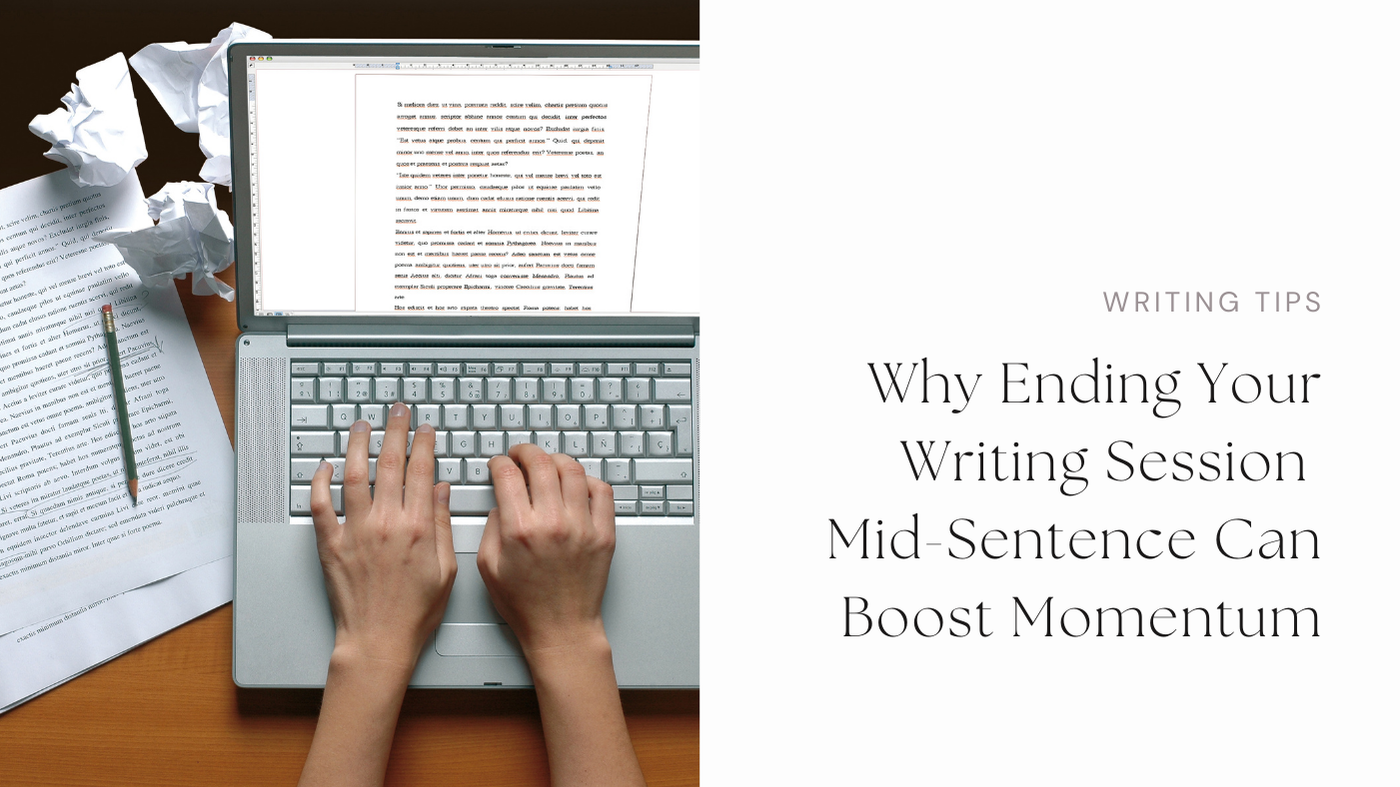
Why Ending Your Writing Session Mid-Sentence Can Boost Momentum
Most writers think the best way to end a writing session is to finish a paragraph, wrap up a scene, or close a chapter. It feels tidy. Complete. Responsible.
But tidy endings can be sneaky momentum killers.
There is a simple technique used by professional writers, journalists, and even novelists who produce work consistently. It sounds counterintuitive, but it works remarkably well:
Stop writing in the middle of a sentence.
Not because you ran out of ideas.
Not because you are stuck.
But because you are not.
Ending mid-sentence gives your brain a clear starting point for the next session, which removes one of the biggest barriers writers face: getting started.
Let’s look at why this works and how to use it effectively.
Why Starting Is Harder Than Writing
Most writers do not struggle with writing once they begin.
They struggle with opening the document.
The blank page carries pressure. It asks questions. It invites doubt. It gives your inner editor too much space to speak.
Where should I start?
Is this the right scene?
What if this is wrong?
Ending mid-sentence eliminates all of that.
When you return, you are not starting from nothing. You are finishing a thought that already exists. Your brain loves continuity, and this small sense of unfinished business pulls you back in naturally.
The Psychology Behind the Technique
There is a psychological principle known as the Zeigarnik Effect. It explains why people remember unfinished tasks better than completed ones.
An unfinished action creates mental tension. Your brain wants closure.
When you stop mid-sentence, you create just enough tension to make your brain curious about what comes next. That curiosity becomes momentum when you sit down to write again.
Instead of resistance, you feel relief.
Instead of dread, you feel direction.
Why This Helps Writers Stay Consistent
Consistency does not come from motivation.
It comes from reducing friction.
Ending mid-sentence reduces friction in several ways:
- You eliminate decision fatigue
- You avoid staring at a blank page
- You bypass the urge to overthink
- You begin with movement instead of hesitation
This is especially helpful for writers who struggle to return to a project day after day. Each session feels less intimidating because the work has already begun.
How to Use This Technique Without Losing Your Place
Some writers worry they will forget what they were trying to say. In practice, the opposite happens.
Here are a few ways to make the technique even stronger:
- Stop at a natural pause
End the sentence at a point where the next word feels obvious. Your brain will remember exactly what you meant.
- Leave a quick note if needed
A short note like “she reacts here” or “describe the room” can act as an anchor.
- Trust your future self
You are more capable than you think. Momentum carries memory with it.
When This Technique Works Best
Ending mid-sentence is especially powerful when:
- You are writing daily or semi-regularly
- You struggle with starting more than continuing
- You are working on a large project like a novel or memoir
- You tend to overthink the opening of each session
It may feel uncomfortable at first, especially if you like closure. But discomfort is often a sign that a habit is being reshaped.
What This Technique Is Not
Ending mid-sentence is not about rushing.
It is not about careless writing.
It is not about leaving your work unfinished forever.
It is a strategic pause.
You are choosing momentum over perfection.
You are choosing continuity over closure.
You will finish the sentence. Just not today.
The Takeaway
Writing momentum is rarely built in big moments.
It is built in small decisions that make tomorrow easier.
Ending your writing session mid-sentence gives your brain a head start. It removes fear, reduces friction, and creates a natural pull back to the page.
The next time you feel the urge to finish everything neatly, try stopping just a little early.
Leave yourself something to come back to.
Your future writing session will thank you.
